
Compliance & Risk Assessments
Audit-ready evidence for every AI agent
Compliance & Risk Assessments shows whose agents reach your most regulated services and how much they can change: five pillars built as one system, from risk rankings to audit-ready evidence.
At a glance
What's in Compliance & Risk Assessments
- Why it's differentEvidence recorded on every call, not reconstructed afterwardsAgent Trail · Tamper-proof · Counts-only redactions
- In-console assessmentsRank the identities whose agents carry the most riskAgent Access · Agent Risk
- NHI Exposure ReviewA read-only review, run by a SecureAuth solutions engineerSystems you choose · Prioritized findings report
- AI Agent Risk AssessmentSee what agents are doing from read-only telemetry10-minute setup · Report contents
- Compliance packsMap gateway safeguards to the frameworks you're audited againstFive packs · Coverage · Import safeguards
- Audit-ready evidenceAn evidence report per framework, ready for your auditorsControl matrix · Export for audit
Why it's different
The evidence already exists when auditors ask
Every agent action is written to a tamper-proof audit trail as it happens, with the person it was done for, so nobody has to reconstruct what an agent did after the fact.
- Each action logs the agent ID, delegating user ID, tool name, parameters, timestamp and result
- The trail is tamper-proof
- Redactions are logged as counts only, never the matched text
Pillar 1 · In-console assessments
Start reviews where the risk is highest
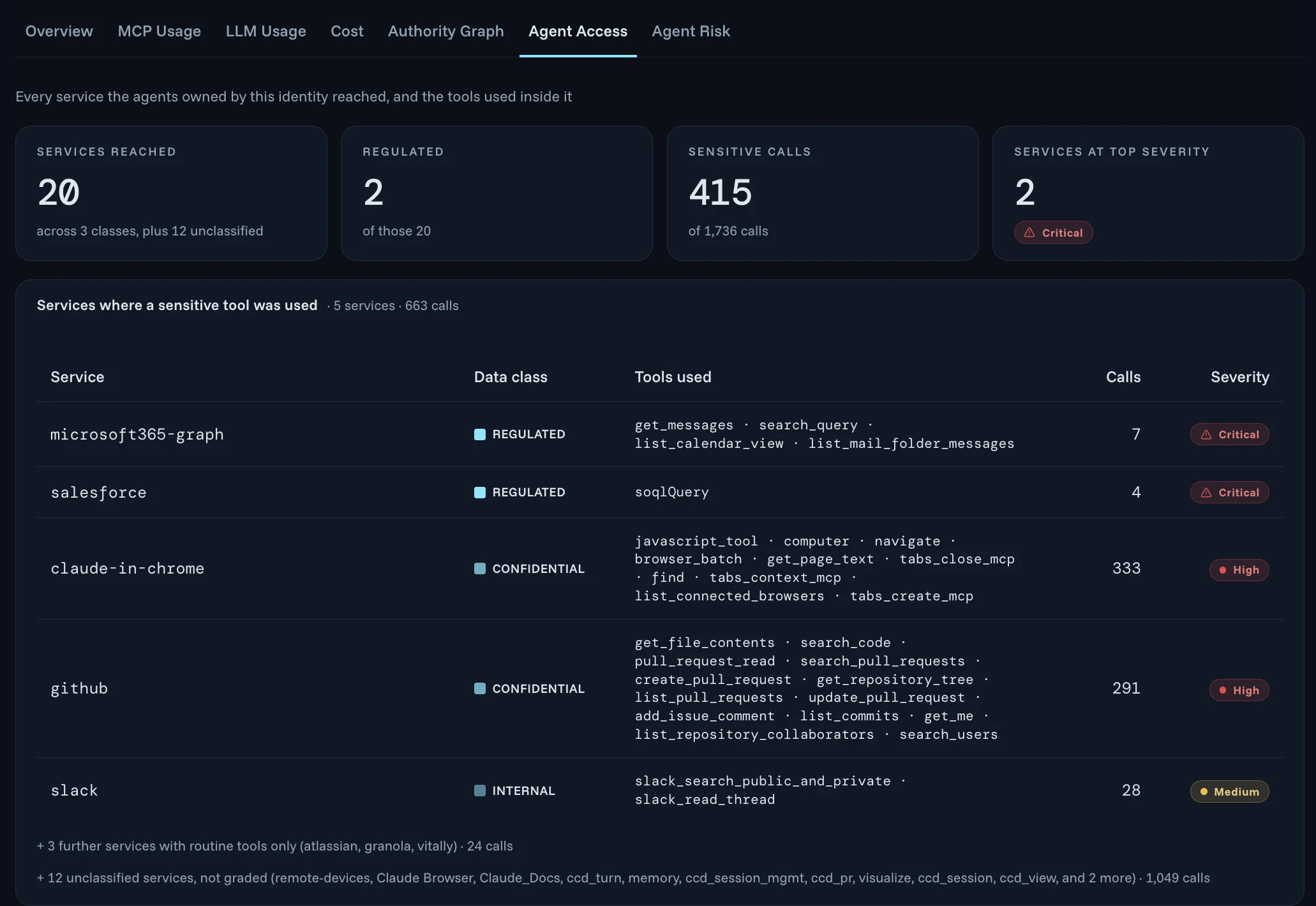
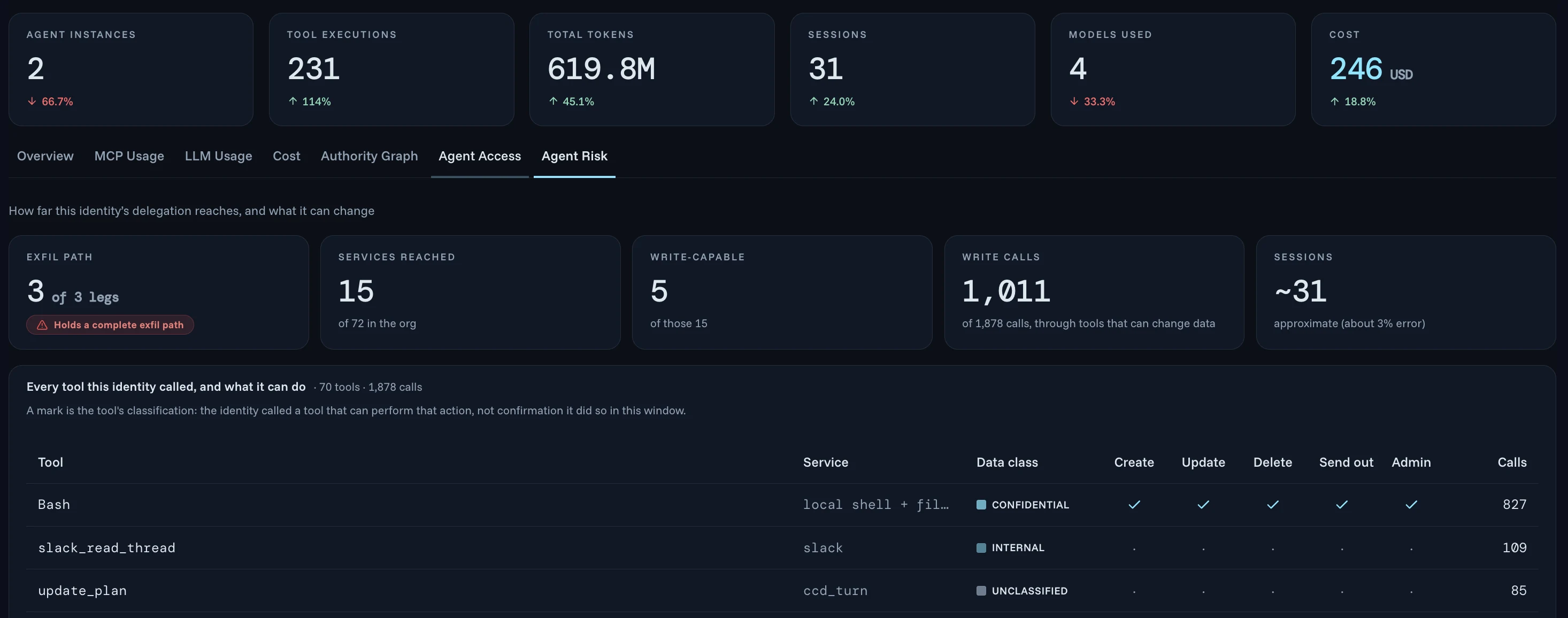
Two assessments in Agent Authority rank the identities whose agents carry the most risk, so your compliance team knows where to look first.
- Agent Access lists first the identities whose agents reach the most regulated services
- Every service reached, its data class, the tools used inside it and how many calls were sensitive
- Agent Risk ranks identities by how much their agents can change
- Whether an identity holds a complete exfil path, and which of its tools can create, update, delete, send out or administer
- The identity's agent instances, tool executions, tokens, sessions, models and cost at a glance
Pillar 2 · NHI Exposure Review
Know every non-human identity you're accountable for
A SecureAuth solutions engineer runs a one-off, read-only review of the systems you choose, then hands over a prioritized findings report: what exists, who owns it, what it can reach, and what to fix first.
- Your identity provider, cloud accounts, code repositories and SaaS apps
- Service accounts, API keys, tokens and their owners, plus every AI agent connected through Agent Authority
- Exposures ranked by severity: never-expiring secrets, over-privileged and ownerless identities, agent sprawl
- The first policies to put in place
Pillar 3 · AI Agent Risk Assessment
See what agents are doing before you set a single rule
Switch on the telemetry feature your AI platforms already offer and point that feed at us. It takes 10 minutes, it's read-only and nothing is installed. The assessment observes; it never sits in your agents' path.
- An agent inventory, with the owner behind each agent
- An activity map and the flow from your people to their agents
- Where risk and token spend concentrate
- The first control to put in place
- 01Agent inventoryEach agent instance seen, and the named owner behind it
- 02Activity mapWhat each instance did, across every surface it reached
- 03User-to-agent flowHow your people drive their agents
- 04Risk concentrationOver-scoped access and sensitive-data reach
- 05Cost signalWhere token spend concentrates
- 06Recommended first controlOne named flow to govern first
Pillar 4 · Compliance packs
Map every safeguard to the framework you're audited against
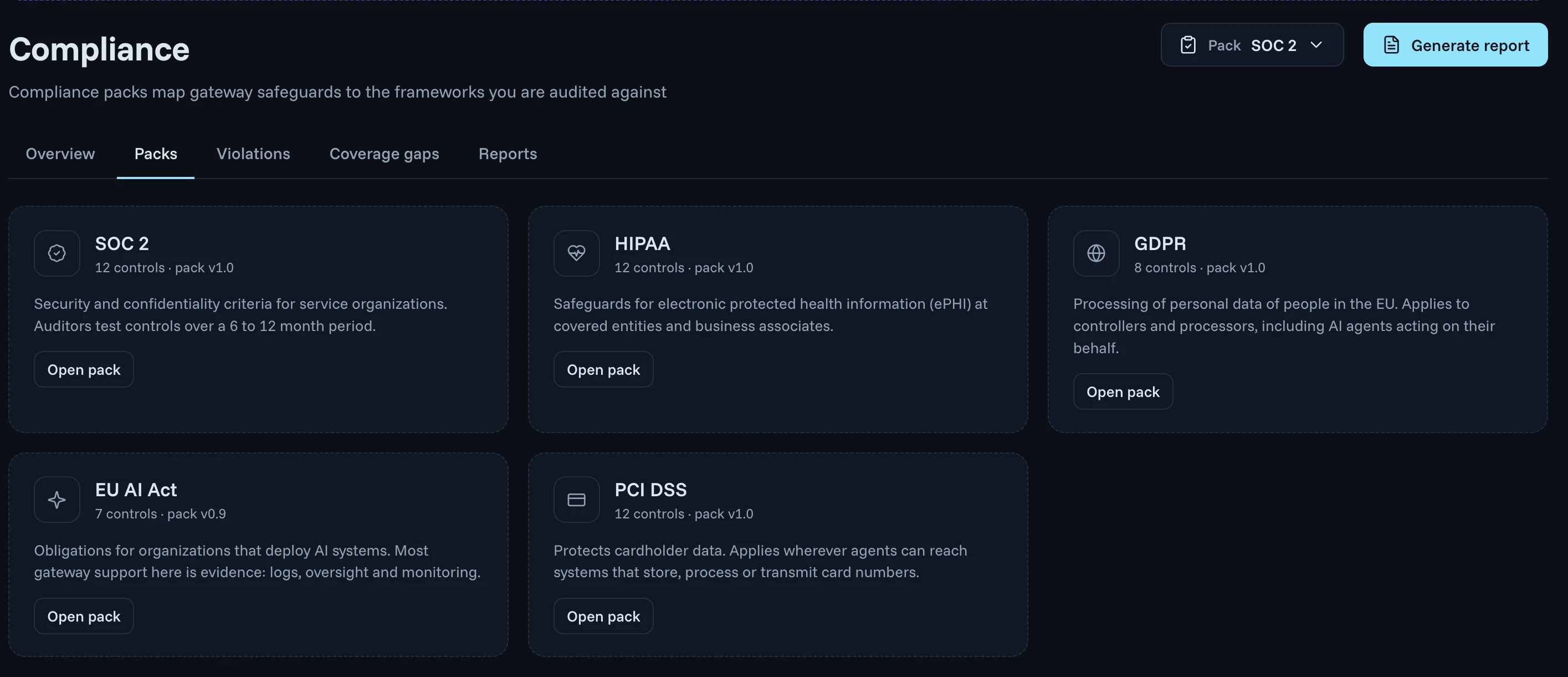
Compliance packs map gateway safeguards to the controls of the frameworks you are audited against, so you can see which controls the gateway already evidences and which it doesn't enforce yet.
- Packs for SOC 2, HIPAA, GDPR and PCI DSS, plus the EU AI Act (pack v0.9)
- For the EU AI Act, most gateway support is evidence: logs, oversight and monitoring
- Generate an evidence report for any pack
Pillar 4 · Compliance packs
See which controls are evidenced, and import what's missing
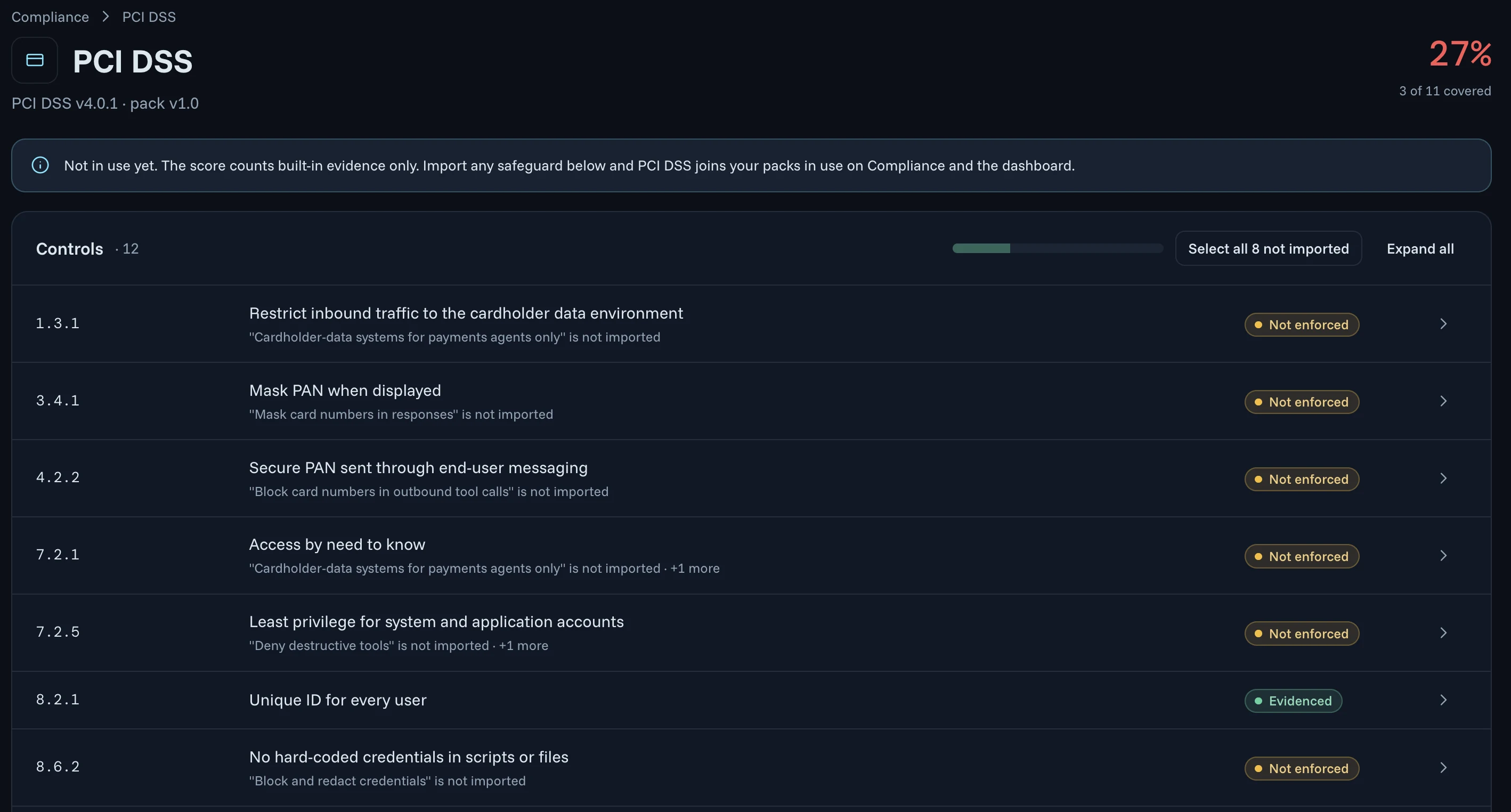
Open a pack to see each control, the safeguard behind it and whether it is evidenced today.
- Each control lists the gateway safeguards that would enforce it, such as masking card numbers in responses
- A status for every control: Evidenced or Not enforced
- The coverage score counts built-in evidence only
- Import any missing safeguard from the pack, one at a time or all at once
Pillar 5 · Audit-ready evidence
Hand auditors the record, not a reconstruction
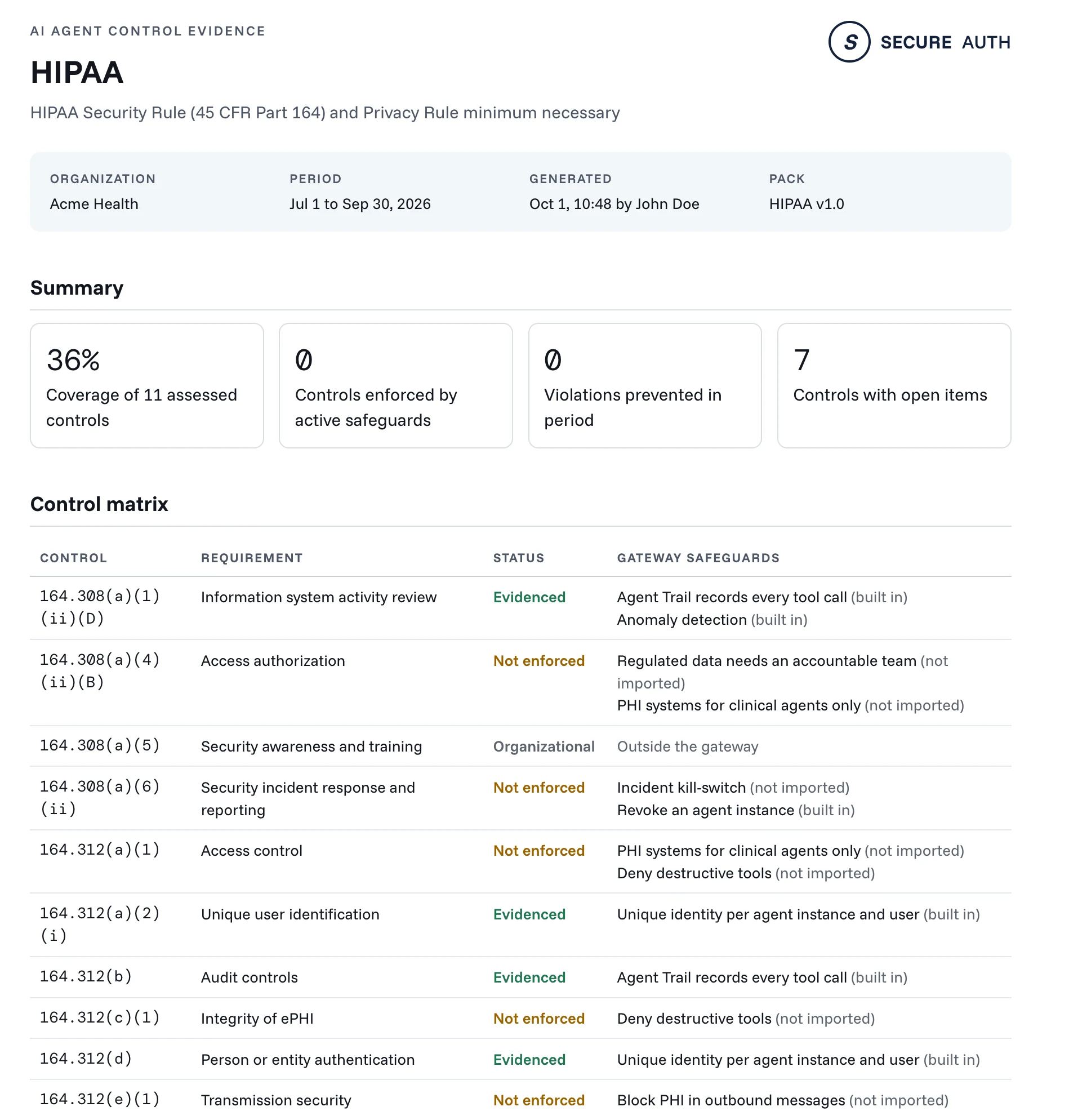
Generate an evidence report for a framework and a period, and hand it over as it was recorded.
- A summary: coverage of the assessed controls, controls enforced by active safeguards, violations prevented and controls with open items
- A control matrix: each requirement, its status and the gateway safeguards behind it
- Controls outside the gateway are marked Organizational
- A compliance-ready export for your auditors
Related capabilities
Go deeper on what these assessments draw on
See how the whole product fits together, or start with the capabilities below.
- NHI InventoryOne register of every agent, service account, key and token, with an owner
- Agent Threats & FindingsRisky identities, anomalies and the fix for each, ranked by severity
- AI Agent GovernanceOwnership, policy and a per-action record for every agent
- MCP AuthorityRules checked on each call an agent makes to your apps
Compliance & Risk Assessments FAQ
What is Compliance & Risk Assessments?
Compliance & Risk Assessments shows whose agents reach your most regulated services and how much they can change. It brings five pillars together as one system: in-console assessments (Agent Access and Agent Risk), the read-only NHI Exposure Review, the AI Agent Risk Assessment, compliance packs that map gateway safeguards to the frameworks you're audited against, and an evidence report for your auditors.
What do the Agent Access and Agent Risk assessments show?
Agent Access lists first the identities whose agents reach the most regulated services. Agent Risk ranks identities by how much their agents can change: whether an identity holds a complete exfil path, how many of the services it reaches are write-capable, and every tool it called with the service's data class and whether that tool can create, update, delete, send data out or administer. Your compliance team knows where to look first.
Does the NHI Exposure Review change anything it reviews?
No. A SecureAuth solutions engineer runs a one-off, read-only review of the systems you choose, such as your identity provider, cloud accounts, code repositories and SaaS apps. It reads and reports: you get a prioritized findings report of what exists, who owns it, what it can reach, and the first policies to put in place.
How long does the AI Agent Risk Assessment take, and what does it report?
Setup takes about 10 minutes. You switch on the telemetry feature your AI platforms already offer and point that feed at SecureAuth. It's read-only, nothing is installed, and it never sits in your agents' path. The report covers an agent inventory with the owner behind each agent, an activity map, the flow from your people to their agents, where risk and token spend concentrate, and the first control to put in place.
Which compliance frameworks does it map to?
Agent Authority ships compliance packs for SOC 2, HIPAA, GDPR, the EU AI Act and PCI DSS. Each pack maps the framework's controls to gateway safeguards and shows which are evidenced and which are not enforced. The EU AI Act pack is version 0.9, and most gateway support there is evidence: logs, oversight and monitoring. A pack's coverage score counts built-in evidence only; import any missing safeguard from the pack, then generate an evidence report for your auditors. Controls such as security awareness training are marked organizational, outside the gateway.
What does the audit trail record for each agent action?
Each action logs the agent ID, the delegating user ID, the tool name, the parameters, a timestamp and the result, in a tamper-proof audit trail with a compliance-ready export for your auditors. Redactions are logged as counts only; the matched text is never recorded.
Have the evidence ready before auditors ask
14-day free trial. Your own Agent Authority tenant.
Start free trial